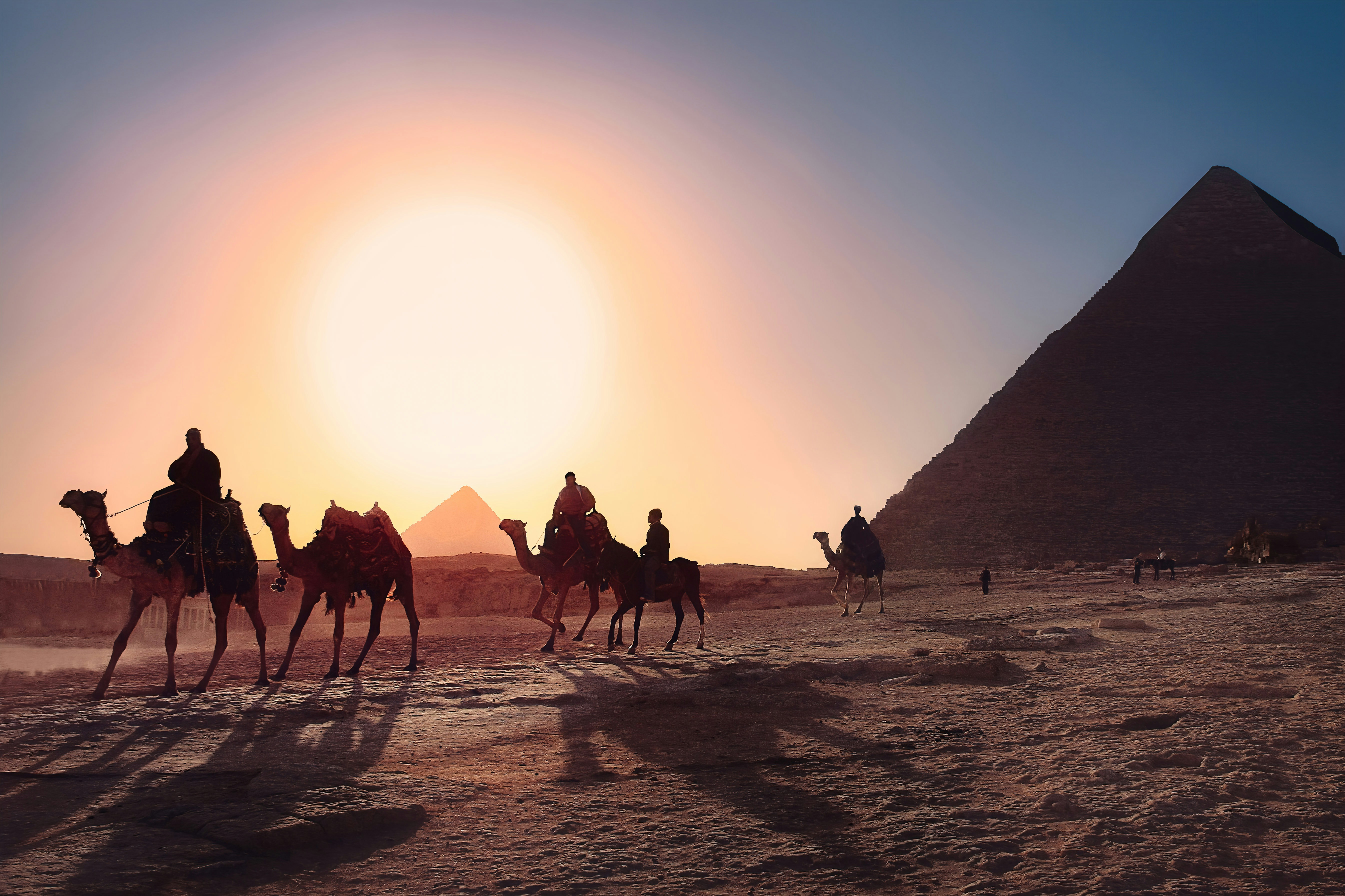
Explore Ancient Egypt: Nile Cruise, Pyramids & Desert Safari
Why Travel to Egypt?
Egypt is a truly fascinating country with a wealth of cultural treasures. Located in the northeast of Africa, it is one of the continent’s most populous nations, with around 110 million inhabitants (as of 2024). The country spans an area of approximately 1 million square kilometers and borders the Mediterranean Sea, the Red Sea, and neighboring countries such as Libya, Sudan, and Israel. The capital city is Cairo, one of the largest and most vibrant metropolises in the Arab world.
Egypt's climate is predominantly hot and dry, with extremely hot summers and mild winters – spring and autumn are especially pleasant times to visit. The official language is Arabic, and the dominant religion is Islam (around 90% of the population are Muslim). There is also a Christian minority, primarily Coptic Christians.
Egypt is famous for its history spanning over 5,000 years, with awe-inspiring landmarks such as the Pyramids of Giza, the temples of Luxor, and the mystical legacy of the ancient pharaohs.
Travel Planning & Preparation
Best Time to Visit Egypt
Egypt has a predominantly desert-like climate with hot, dry summers and mild winters. During the summer months (June to August), temperatures often rise above 40°C, especially in the interior, making sightseeing quite exhausting. Along the coasts, the heat is slightly milder, but still intense. The most pleasant time to travel is between October and April – particularly March/April and October/November are considered ideal for tours, as daytime temperatures are comfortably warm (between 22 and 30°C) and evenings are pleasantly cool. For beach holidays on the Red Sea, spring and autumn are also perfect. Those who can tolerate the summer heat will benefit from fewer tourists and lower prices.
Entry Requirements & Vaccinations
Entry Requirements
To enter Egypt, a visa is generally required, which can be obtained either in advance online as an e-visa or upon arrival at the airport (visa on arrival, valid for 30 days) for a fee of about 25 USD (note: cash only is accepted!). Whether you need a visa for your entry and how to apply for it can be found on the official website of the Ministry of Interior. For the online application, allow at least 7 days for processing. Your passport must be valid for at least 6 months upon entry. For tourist stays of up to 30 days, the standard visa is usually sufficient (as of April 2025).
Vaccinations
There are no mandatory vaccinations, but depending on your travel route and duration of stay, vaccinations against Hepatitis A are recommended, and for longer stays also Typhoid, Rabies, and Hepatitis B. A travel health insurance that includes medical evacuation is highly recommended. Before your trip, it’s worth checking the latest updates from the Foreign Office.
Getting Around
There are various ways to get around in Egypt: domestic flights are ideal for covering longer distances between Cairo, Luxor, and Aswan – they save a lot of time. Train travel, such as between Cairo and Luxor, is possible but often delayed and less comfortable. If you value comfort, it’s better to opt for domestic flights on long routes. In cities like Cairo, Uber is a recommended option. In smaller cities like Luxor or Aswan, taxis and horse-drawn carriages are common. Here, you should always negotiate the price before the ride. To be on the safe side, it's often best to have taxis arranged through your hotel.
Money & Currency
The official currency is the Egyptian Pound (EGP), but at many tourist sites, US dollars or euros are also accepted – especially for accommodations or tours. Entry fees to major attractions usually range between 200–500 EGP, while special tombs or museums can be more expensive. Important to know: tickets at government-run attractions can often only be paid by card, preferably with a credit card. Still, cash is essential – especially for tips, toilet use (usually 10 EGP), small purchases, or rides with taxis and carriages.
Tipping (Baksheesh)
In Egypt, tipping – or "baksheesh" – is an integral part of daily life and is expected in many situations: from hotel staff and drivers to guides, restroom attendants, or even when photographing locals. More than once, we found ourselves in situations where vendors at temples pointed out "secret" photo spots – and then asked for a tip. As a general guideline, 5–20 EGP is common for small services, 10–50 EGP for luggage handlers or restrooms, and 50–100 EGP for half-day guides. It’s highly recommended to always carry some small change, ideally in Egyptian pounds.
Safety
The security situation in Egypt (as of April 2025) is currently stable overall, but there are regional differences that travelers should be aware of. The Austrian Foreign Ministry (BMEIA) and the German Federal Foreign Office (AA) provide specific travel advisories. Always check the latest updates before your trip.
In tourist areas such as Cairo, Luxor, Aswan, and along the Red Sea, the security risk is considered low. At major attractions like Luxor, Aswan, or the Pyramids of Giza, police, military, and private security forces are highly visible. Checkpoints, bag inspections, and even armed escorts on certain routes are not uncommon. As long as you follow local instructions and behave respectfully, you can feel safe and well looked after at the major archaeological sites.
That said, there remains a nationwide risk of terrorist attacks, which in the past have mostly targeted security forces in the Sinai region. Some incidents have also involved Coptic Christian sites and, on rare occasions, foreign interests.
Regional Particularities
Sinai Peninsula: Travel to the northern part of the Sinai Peninsula, the North Sinai Governorate, and the Egyptian-Israeli border area – with the exception of the immediate coastal strip and the border town of Taba – is strongly discouraged. Military operations are ongoing in these regions due to past terrorist attacks.
Sahara and Border Areas: Travel to remote areas of the Sahara, including the border regions with Libya and Sudan, is prohibited. The Egyptian authorities have declared these regions restricted zones. Excursions into these areas are only possible with special permits and in the company of authorized tour operators.
Landmine Risk: Minefields are often poorly marked, especially in the Sinai, in some undeveloped coastal areas of the Red Sea, along the undeveloped Mediterranean coastline west of El Alamein, and in border areas with Sudan and Libya. Travelers should exercise caution and stay strictly on official roads and marked paths in these regions.
Behavioral Recommendations
Avoid Demonstrations: Demonstrations and large gatherings – such as those after Friday prayers near mosques – should be avoided entirely. Unauthorized demonstrations are illegal, and participating in them can lead to prosecution.
Conduct in Public: Critical comments about Egypt or political statements made in public may be considered criminal offenses, such as insulting or defaming the country or the president. Identity checks and searches – including of mobile phones – do occur.
Crime: The overall crime rate in Egypt is relatively low. However, petty crimes like pickpocketing and occasional assaults, particularly targeting women, can happen. In tourist areas like Hurghada, some taxi drivers have been known to engage in fraudulent or extortionate behavior.
Further information: German Federal Foreign Office
Regional Particularities
Sinai Peninsula: Travel to the northern part of the Sinai Peninsula, the North Sinai Governorate, and the Egyptian-Israeli border area – with the exception of the immediate coastal strip and the border town of Taba – is strongly discouraged. Military operations are ongoing in these regions due to past terrorist attacks.
Sahara and Border Areas: Travel to remote areas of the Sahara, including the border regions with Libya and Sudan, is prohibited. The Egyptian authorities have declared these regions restricted zones. Excursions into these areas are only possible with special permits and in the company of authorized tour operators.
Landmine Risk: Minefields are often poorly marked, especially in the Sinai, in some undeveloped coastal areas of the Red Sea, along the undeveloped Mediterranean coastline west of El Alamein, and in border areas with Sudan and Libya. Travelers should exercise caution and stay strictly on official roads and marked paths in these regions.
Behavioral Recommendations
Avoid Demonstrations: Demonstrations and large gatherings – such as those after Friday prayers near mosques – should be avoided entirely. Unauthorized demonstrations are illegal, and participating in them can lead to prosecution.
Conduct in Public: Critical comments about Egypt or political statements made in public may be considered criminal offenses, such as insulting or defaming the country or the president. Identity checks and searches – including of mobile phones – do occur.
Crime: The overall crime rate in Egypt is relatively low. However, petty crimes like pickpocketing and occasional assaults, particularly targeting women, can happen. In tourist areas like Hurghada, some taxi drivers have been known to engage in fraudulent or extortionate behavior.
Further information: German Federal Foreign Office
What to Pack?
For a trip to Egypt, you should be prepared for all eventualities, as the climatic conditions can vary greatly. During the day, especially in the summer months or in the desert, temperatures often rise above 35°C – light, breathable clothing made of cotton or linen is ideal. A head covering to protect against the intense sun, high-SPF sunscreen, sunglasses, and plenty of drinking water are also essential.
At night, however, it can cool down significantly, especially in the desert, in spring or autumn – so a light jacket and a sweater should also be in your luggage.
For visits to mosques or other religious sites, modest clothing that covers shoulders and knees is also recommended. Additionally, your luggage should include: your passport, a visa, and a well-stocked travel first-aid kit.
You can find a packing list here.
Food & Drinks
Egyptian cuisine is simple, flavorful, and often vegetarian – particularly popular dishes include Koshari (lentils, pasta, rice, and tomato sauce), Ta’amia (Egyptian falafel made from fava beans), or Fattah (rice, bread, and meat in garlic sauce). Grilled fish, fresh flatbread, and dates are also typical. Street food can be delicious and relatively inexpensive. However, make sure the food is freshly prepared and the stalls are clean and well-frequented – these places tend to have the highest turnover. Water should be consumed only from bottles, even when brushing your teeth. If you have a sensitive stomach, it's also advisable to avoid ice cubes, raw fruit (that you haven’t peeled yourself), and fresh salads, as they might have been washed with tap water. Cooked or thoroughly grilled dishes are generally safe.
10 Days Egypt – Itinerary in Detail
Day 1: Arrival in Cairo & Accommodation
After around 7 hours of travel by plane, departing from Vienna Airport with a layover in Antalya (Turkey), we finally arrived at Cairo International Airport at 6 PM. The counter for the Visa on Arrival was located right in the arrival hall. We bought two tickets (stickers to be placed in the passport) for 25 USD each. Note: Cash only! (As of 2025) It’s best to bring the money from home so you don’t have to deal with one of the (often non-functional) ATMs.
Additionally, a form with some personal details (such as place of birth, nationality, passport number, etc.) had to be filled out and handed in at passport control along with the visa. The whole process was fairly easy and quick. A taxi driver then took us to our hotel in Cairo.
Day 2: Bahariya Oasis, Black Desert, Hot Spring & White Desert
Bahariya Oasis
Despite initial safety concerns, we booked a desert safari via Tourradar. At 5 AM, a driver picked us up from the hotel. After about 4 hours of driving from Cairo, we reached the Bahariya Oasis – a charming place in the Western Desert. As part of the Sahara, this region stretches west of the Nile to the Libyan border and makes up about two-thirds of Egypt's total area. At the hotel, we were welcomed with black tea and a generous lunch. We charged our phones, packed the essentials from our suitcases into a daypack, and boarded the 4x4 Jeep.
Black Desert, Hot Spring & Crystal Mountain
Soon after, we reached the Black Desert, known for its volcanic-looking hills and sand areas covered with black basalt rock. After about an hour of driving on a well-paved road, we stopped at a hot spring, where a few tourists were already enjoying a soak. The next stop was the Crystal Mountain – a small but impressive hill formed through geological activity that exposed crystalline rock through erosion. The hill was speckled with barite and quartz crystals that sparkled magically in the sunlight.
Agabat Valley
On the way to the White Desert, we arrived at the Agabat Valley, also known as the “Valley of Wonders.” At the entrance, we made a short stop to climb one of the surrounding hills. From the top, we had a stunning view of the impressive limestone formations, which stood in stark contrast to the golden sand dunes. One of the absolute highlights of our trip!
White Desert
We continued at high speed over endless sandy and gravel tracks. We enjoyed the adrenaline rush of dune bashing until we finally reached the White Desert (White Desert Protected Area) with its countless bizarrely shaped limestone formations. Located about 500 kilometers southwest of Cairo, the White Desert is a unique natural wonder. It formed around 80 million years ago from the lime sediments of animals and corals that settled on the sea floor. Due to tectonic movements, the area was uplifted and dried out, while wind, sand, and temperature changes shaped the distinctive limestone formations that define the landscape today. The soft limestone has been sculpted into spectacular shapes resembling animals (Chicken Rock, Rabbit Rock, Camel Rock) or other forms (e.g., a mushroom or a tower).
Camping in the White Desert
Before reaching the camp, we witnessed a breathtaking sunset from a small hilltop. Meanwhile, our guides prepared the campsite. Dinner was freshly cooked using a camp stove and fire – vegetables, BBQ, and rice, followed by black tea. We sat around the fire, sharing stories and listening to drumming and cheerful songs from our guides. All around us – nothing but silence. Soon after, we sank into our tents – wrapped in sleeping bags and thick blankets – and drifted off under the clear starry sky. This night in the middle of the quiet, white wonderland was truly an unforgettable experience!
However, it's good to know: The overnight stay – as is usually the case – was in simple tents designed for a maximum of two people. There is also the option to sleep on a mattress under the open sky. Sleeping bags and thick blankets were provided by the tour operator, and they were definitely needed in the cold, clear night. Don’t forget to bring plenty of warm clothing (thick sweater or jacket and light thermal underwear), as temperatures can drop significantly at night. While most stops did have sanitary facilities, they were far from European standards. So don’t be surprised if a hole in the ground behind a wooden screen is called a toilet. In the desert, nature is your only option for relieving yourself. The outdoor toilet was basically the desert sand. Around the tent camps, you could already find countless human traces behind the rock formations. Do not expect any luxury on this tour!
Day 3: White Desert & Hot Spring
We woke up early at 5:30 AM. While we packed our things, our guides prepared breakfast. There was soft cheese, cucumbers, tomatoes, bread, instant noodles, cookies, coffee, and tea. We also tried Halawa (also known as Halva) – a traditional sweet specialty from Egyptian and Middle Eastern cuisine made from sesame paste, honey, and sugar. A bit later, we boarded our jeeps again, which took us back to the Bahariya Oasis after several stops in the White Desert (including the Panorama viewpoint and Mushroom Rock) and a visit to a hot spring. Once there, we picked up our suitcases and took a minibus for the approximately four-hour return journey to Cairo.
Review of the Tour 'Bahariya Oasis, Black Desert, Hot Spring & White Desert'
Despite initial safety concerns – after all, one often hears about political tensions or the general remoteness of the region – we felt completely safe and well taken care of throughout the entire White Desert tour.
Camping amid this surreal landscape of white limestone formations, under a breathtaking starry sky, was an experience we won’t forget anytime soon. The silence, the light, the vastness – it all made everyday life fade away entirely.
The tour was not only well organized but also absolutely worth the price. Anyone wanting to experience Egypt away from the classic tourist routes will find here a unique mix of adventure, natural wonder, and deep tranquility. A true highlight of our trip!
Day 4: Pyramids of Giza, National Museum & Khan el-Khalili Bazaar
Pyramids of Giza
The next day marked the beginning of our second, this time 7-day, tour, which we had booked in advance via Tourradar. At 9 AM, our guide picked us up from the hotel to take us to the Pyramids of Giza – one of the Seven Wonders of the Ancient World. When we arrived, the area was already bustling – tourist groups, vendors, camels, and horses moving chaotically across the vast site. We were constantly approached by vendors offering camel rides, photos, or souvenirs.
We couldn't shake the feeling that, despite the early hour, we were already too late. So it’s best – not just because of the crowds, but also due to the heat – to arrive as early as possible (opening hours start at 6 AM).
The pyramids can be accessed through two main gates:
- ›Entrance at the Great Pyramid (Pyramid of Khufu): This gate is located on the northern side of the Giza Plateau, near the Marriott Mena House Hotel.
- ›Entrance at the Sphinx: Another entrance lies in front of the Great Sphinx, Egypt’s most famous statue.
Tickets can be purchased at both entrances. There are various options (e.g., with or without access to the interiors). Tickets can also be bought online. Our guide advised us not to go inside the pyramids. Whether it's worth climbing through the narrow passages leading to an empty chamber is something we can’t fully assess here. We used the northern gate and bought our ticket via one of the self-service kiosks. One of the many tourist buses eventually brought us to the pyramids, which towered impressively before us.
Some brief facts: The Pyramids of Giza were built over 4,500 years ago during Egypt’s 4th Dynasty and are among the most significant architectural achievements in human history. They served as monumental tombs for the pharaohs Khufu (Cheops), Khafre (Chephren), and Menkaure (Mykerinos), intended to secure their divine status beyond death. The largest, the Great Pyramid of Khufu, originally stood at around 146 meters and was the tallest structure in the world for millennia. It consists of over 2.3 million limestone blocks, each weighing several tons. Due to erosion and the loss of its outer casing, it now reaches a height of about 138 meters. Despite centuries of study, it remains unclear exactly how the pyramids were built – theories range from ramp systems to sophisticated lifting techniques. Inside the Great Pyramid are various passages and chambers, including the King’s Chamber, the Grand Gallery, and mysterious shafts whose purposes are still not fully understood. Surrounded by temple complexes, smaller pyramids, and the legendary Sphinx, the Giza Plateau represents the pinnacle of ancient Egyptian architecture.
National Museum of Egyptian Civilization
After surviving the obligatory sales stops at a papyrus and perfume shop, we visited the National Museum of Egyptian Civilization (NMEC) in Cairo. Alternatively, we could have gone to the Egyptian Museum of Antiquities (Tahrir Museum). Here’s a quick comparison:
Egyptian Museum (Tahrir Museum)
- ›Location: Tahrir Square, Cairo
- ›Opened: 1902
- ›Focus: Ancient Egypt – especially the Pharaonic era
- ›Highlights:
- ›- Original burial artifacts of Tutankhamun (including his golden funerary mask)
- ›- Countless sculptures, mummies, jewelry
- ›- Lots of objects – but somewhat chaotic and outdated presentation, not air-conditioned
National Museum of Egyptian Civilization (NMEC)
- ›Location: Al-Fustat, Old Cairo
- ›Opened: 2021
- ›Focus: Complete Egyptian history – from prehistory to modern times
- ›Highlights:
- ›- The Royal Mummy Hall (including Ramses II and Hatshepsut)
- ›- Modern permanent exhibition on Egyptian civilization through the ages
- ›- Interactive displays, multimedia, air-conditioned
Khan el-Khalili Bazaar
The final stop of our tour was the Khan el-Khalili Bazaar – one of the oldest and most famous markets in the Middle East. In its narrow alleys, you’ll find everything your heart desires – from handicrafts, perfumes, and gold jewelry to spices, ornate lamps, souvenirs, and oriental cafés.
Soon after, we returned to the hotel to pack our bags, as our domestic flight to Aswan was scheduled for 2 AM.
Day 5: Cruise Check-In, Aswan High Dam, Temple of Philae & Nubian Village
After about a one-hour flight from Cairo to Aswan, a driver met us at the airport and took us to our cruise ship – the MS Zeina. Despite a sleepless night, our tour started shortly thereafter.
Aswan High Dam
Our first stop was at the Aswan High Dam, which was built between 1960 and 1971. Besides numerous tourists, many security personnel were also present at the site. We took a photo of the dam, caught a glimpse of Lake Nasser, and received some information about the location. We learned that the Aswan High Dam – with a length of about 3.8 kilometers, a height of 111 meters, and a volume of around 43 million cubic meters – regulates the water flow of the Nile. The dam protects the Nile Valley from flooding, enables the year-round irrigation of fields, and produces about 10–15% of Egypt's electricity demand through its hydroelectric power plant. The construction created the over 500 km long Lake Nasser, one of the largest artificial lakes worldwide. Although the dam brought enormous economic benefits, it also led to the resettlement of over 100,000 Nubians and required the relocation of several temples, including the famous Temple of Abu Simbel.
Temple of Philae
Our next stop was the beautiful Temple of Philae, located on a small island. We reached it by boat. The temple is dedicated to the goddess Isis and mostly dates back to the Greco-Roman period. However, construction began already in the Pharaonic era. Until the 6th century AD, the Temple of Philae was an important religious center. Due to the construction of the Aswan Dam, it was relocated in the 1960s to Agilkia Island to protect it from flooding. Today, it is part of the UNESCO World Heritage Site and a popular attraction definitely worth a visit!
Nubian Village
After a short lunch break on the ship, we set off in the afternoon to the Nubian Village. A small, colorfully decorated boat picked us up from our dock in Aswan. From afar, we could already see the typical houses characteristic of the Nubians.
We landed on the Nile’s shore and climbed some steps. At the top, we made our way past a multitude of merchants trying to sell us various goods. Eventually, we reached our hosts who invited us into their home. They showed us two crocodiles, which they kept as a tourist attraction in a dry pit. For a tip, you could take a photo with a juvenile crocodile. We were less enthusiastic about this.
Shortly after, we were served black and hibiscus tea, bread, and some local delicacies (date molasses, fresh cheese, and halawa), while our guide gave us some information about the Nubians – a people with their own language, culture, and history dating back to the time of the ancient Egyptian pharaohs. Originally, the Nubians came from the area along the Nile in southern Egypt and northern Sudan – a region historically known as Nubia. Powerful kingdoms once existed there in antiquity, sometimes competing with the Egyptian pharaohs or even ruling Egypt. The Nubian culture is rich in traditions – from architecture to music and dance to a strong oral storytelling tradition. Today, the Nubians still speak various Nubian languages, such as Nobiin or Kenzi-Dongolawi, although these are increasingly being replaced by Arabic. In the 20th century, the Nubians suffered a major disruption when large parts of their homeland were flooded due to the construction of the Aswan Dam. Entire villages and ancient sites had to be abandoned or relocated – such as the famous temples of Abu Simbel and Philae. Despite this, the Nubians proudly maintain their cultural identity today. This is especially visible in their colorful house paintings, elaborate handicrafts, and their vibrant clothing.
A Nubian woman offered us henna tattoos. We politely declined and decided to stroll a bit through the narrow, sand-covered alleys, where merchants, tourists, as well as dogs and camels mingled. Somewhat disappointed by the sparse program, which felt more like a sales tour, we finally made our way back. After sunset, we arrived back at our cruise ship where we would spend the night.
Day 6: Abu Simbel, Kom Ombo Temple & Museum of Mummified Crocodiles
Abu Simbel
At dawn, we set off for the temple of Abu Simbel, located on the western shore of Lake Nasser, near the border with Sudan. As a UNESCO World Heritage Site, it attracts thousands of visitors annually. The temple was built in the 13th century BC under Pharaoh Ramses II and is especially known for its monumental statues of the king carved into the rock. The temple is not only architecturally impressive but also a masterpiece of engineering: In the 1960s, it was completely relocated in a spectacular operation to save it from the rising waters of the newly created reservoir.
Next to the large temple of Ramses II is a second, smaller temple dedicated to the goddess Hathor and Ramses’ wife Nefertari. The queen is depicted here on eye level with the pharaoh – a rarity in Egyptian architecture. This temple was also relocated in the 1960s in an elaborate rescue effort and is now an integral part of every visit to Abu Simbel.
It was four o’clock in the morning when we began the four-hour drive to the temple. On the way, we had to first join a kilometer-long car queue, which our driver was able to bypass shortly afterward. When we arrived at the temple, numerous tourist buses were already there. The sun was blazing overhead as we made our way through the crowds of people. A long queue had already formed at the entrance to enter the temple’s interior. The heat was almost unbearable and there was hardly any shade on the site. But the long journey and waiting were definitely worth it! Abu Simbel is rightly considered one of the most impressive monuments of ancient Egypt. The temple was absolutely breathtaking. For those who want to enjoy this fascinating place without the burning heat and hustle, a visit in the early morning hours is recommended.
Temple of Kom Ombo
After our return, the cruise ship departed. It was already dark when we reached the town of Kom Ombo. When we disembarked, a swarm of children rushed up to us, persistently offering their souvenirs. We bought our tickets at the counter and followed our guide, who led us to the beautifully illuminated temple. It was dedicated to a pair of gods – the falcon-headed Horus and the crocodile-headed Sobek. Particularly fascinating is the part of the temple dedicated to Sobek, the god of fertility and water.
After visiting the temple, we toured a small museum that was part of the complex. It housed mummified crocodiles, which were once ritually buried in honor of Sobek. These unusual relics provide an exciting insight into the religious beliefs of ancient Egypt – showing how closely nature, wildlife, and the belief in gods were connected. Shortly afterward, we returned to the cruise ship, which was to take us to Edfu.
Day 7: Edfu Temple, Karnak Temple & Luxor Temple
Edfu Temple
Before breakfast, we set off for the Temple of Edfu, which we reached after about 20 minutes by car. The temple was built between 237 and 57 BC during the Ptolemaic period and is dedicated to the falcon-headed god Horus. It is one of the best-preserved temples in Egypt. When we arrived at the temple, some tourists were already waiting to enter. By the time the gates opened, a huge queue of people had already formed at the entrance. So here, too, it is advisable to arrive as early as possible. After the visit, we continued our journey by cruise ship and arrived in Luxor in the afternoon.
Karnak Temple
The Temple of Karnak in Luxor is the largest religious building ever constructed – a massive complex that was constantly expanded over more than 2,000 years. Especially impressive is the Great Hypostyle Hall, where 134 massive columns arranged in 16 rows create an almost mystical atmosphere. Karnak was the central sanctuary of the god Amun-Ra, but was also dedicated to other gods like Mut and Khonsu. Due to its monumental size and precise alignment with the cardinal directions, the temple is not only spiritually but also architecturally a masterpiece. Tip: A visit early in the morning or late in the afternoon is worthwhile – then a golden light falls over the ancient walls and the site is not yet crowded.
Luxor Temple
About three kilometers south of Karnak lies the Temple of Luxor, right in the heart of the city. The temple was mainly built under the pharaohs Amenhotep III and Ramses II and served not only religious purposes but also political representation. Particularly worth seeing are the colossal statues of Ramses II at the entrance as well as the well-preserved reliefs inside. Luxor was once connected to the Karnak temple by a procession avenue – lined with hundreds of sphinxes, some of which have been partially uncovered again today.
Day 8: Hot Air Balloon Ride, Valley of the Kings, Hatshepsut Temple & Colossi of Memnon
Hot Air Balloon Ride over Luxor
Early in the morning, a driver picked us up from our ship to take us to the site where our hot air balloon was supposed to take off. Unfortunately, the sun had already risen and when we arrived, numerous balloons were already visible in the sky. Nevertheless, it was an absolutely unforgettable experience. From the air, a spectacular view of the Nile Valley opened up, including the Temple of Hatshepsut, the Valley of the Kings, and the green fields between desert and river. The ride lasted about 45 minutes. Around us, more colorful hot air balloons rose. A true spectacle. Tip: Choose your spot in the basket as far to the outside as possible, because it can get quite hot under the gas burner. Also, this gives you a better view of the landscape around you.
Valley of the Kings
Half an hour after our return, the next item on the program was already scheduled: The Valley of the Kings. There – in magnificently decorated burial chambers hidden in a barren desert landscape – 63 of the most important pharaohs in the history of Ancient Egypt were buried. Among them is the world-famous tomb of Tutankhamun, discovered almost untouched in 1922. For almost 500 years, from the 16th to the 11th century BC, the valley served as a burial site for kings, their families, and their possessions. The walls of many tombs are covered with colorful scenes from ancient Egyptian beliefs about the afterlife, telling of the soul’s journey through the underworld. Despite the millennia, the depictions appear surprisingly vivid. In 1979, the Valley of the Kings was declared a World Heritage Site.
As we got out of the car, the heat hit us. The valley, which was cut through by steep rocky walls, was absolutely impressive. The sun was blazing from the sky. Inside the narrow tomb chambers it was often stuffy, and there were sometimes many stairs to climb. Additionally, there were hardly any shady spots on the site. So don’t forget to bring plenty of drinking water, sunscreen, sunglasses, and a hat during your visit.
Good to know: At the ticket counters, a standard ticket can be purchased, which includes access to three tombs of your choice. For special tombs, such as those of Seti I, Ramses V & VI, or Tutankhamun, extra tickets must be purchased. Also not included in the entrance fee is the transport with small electric shuttles that run back and forth between the ticket office and the entrance. Since the approximately 1-kilometer-long walk is in the sun, the shuttle can be helpful especially for families with children or older visitors. The shuttles can be used for an additional fee of about 10–20 EGP per person and run continuously.
Hatshepsut Temple
After a short sales stop at an alabaster workshop, we made our way to the Temple of Hatshepsut, which majestically rose from the surrounding rocky landscape. The temple was built in the 15th century BC for Queen Hatshepsut, one of the few female pharaohs, and impresses with its clear lines and symmetrical terraces. The temple tells in colorful reliefs of Hatshepsut’s divine origin, her accession to power, and even an expedition to the legendary Punt – an impressive testament to female rule in ancient Egypt and definitely worth a visit.
Colossi of Memnon
On the way back, as the last program point of our tour, we visited the Colossi of Memnon – two massive seated stone statues that have guarded the plain of Thebes on the west bank of the Nile for over 3,400 years. They represent Pharaoh Amenhotep III and once stood at the entrance of his enormous temple complex, which is now almost completely destroyed. Each statue is about 18 meters tall and carved from a single block of stone. In antiquity, the colossi became famous because one of the figures seemed to "sing" mysteriously at sunrise – a phenomenon probably caused by cracks in the stone and temperature changes that fascinated many travelers.
At the end of our tour, we spent the next few hours at a hotel in Luxor until we were taken to the airport to fly back to Cairo.
Day 9: Shopping in Cairo, Check-Out & Check-In
At 1 a.m., we checked into our hotel in Cairo and after a long sleep spent a quiet day in the city. For those looking for a shopping mall, … is a good choice. Here you can find a wide selection of groceries at affordable prices. Around 2 p.m., we left the accommodation provided by the tour operator and checked into the Panorama View Pyramids Hotel that we had booked for the last day. The hotel is only a few minutes from the entrance to the pyramids and offers a great view of them.
Day 10: Pyramids of Giza & Flight Home
On the last day of our trip, we made sure to visit the pyramids one last time. Although the pyramids were supposed to open at 6 a.m., the ticket counter only opened at 8 a.m. There was already a queue forming there. We bought two tickets and set off. Early in the morning it was still not too hot and pleasantly not crowded. It is therefore recommended to arrive as early as possible. After enjoying a balanced Egyptian breakfast on the hotel rooftop terrace, we were taken by a driver to the airport. After about three hours, we finally arrived back at Vienna airport. What an eventful journey.
Conclusion
Our Egypt trip was a complete success – although accompanied by little sleep and a full schedule. The numerous temples were absolutely impressive, and the Nile cruise was a wonderful experience. The ride with the hot air balloon in Luxor perfectly rounded off the trip. A special highlight on our tour was also the overnight stay in the White Desert – under the clear starry sky, amidst a fascinating limestone landscape, in almost complete silence.